

Who Really Pays Idaho’s Property Taxes? It Isn’t Who You Think.
A clear look at why Idaho families are carrying more of the load than ever before.
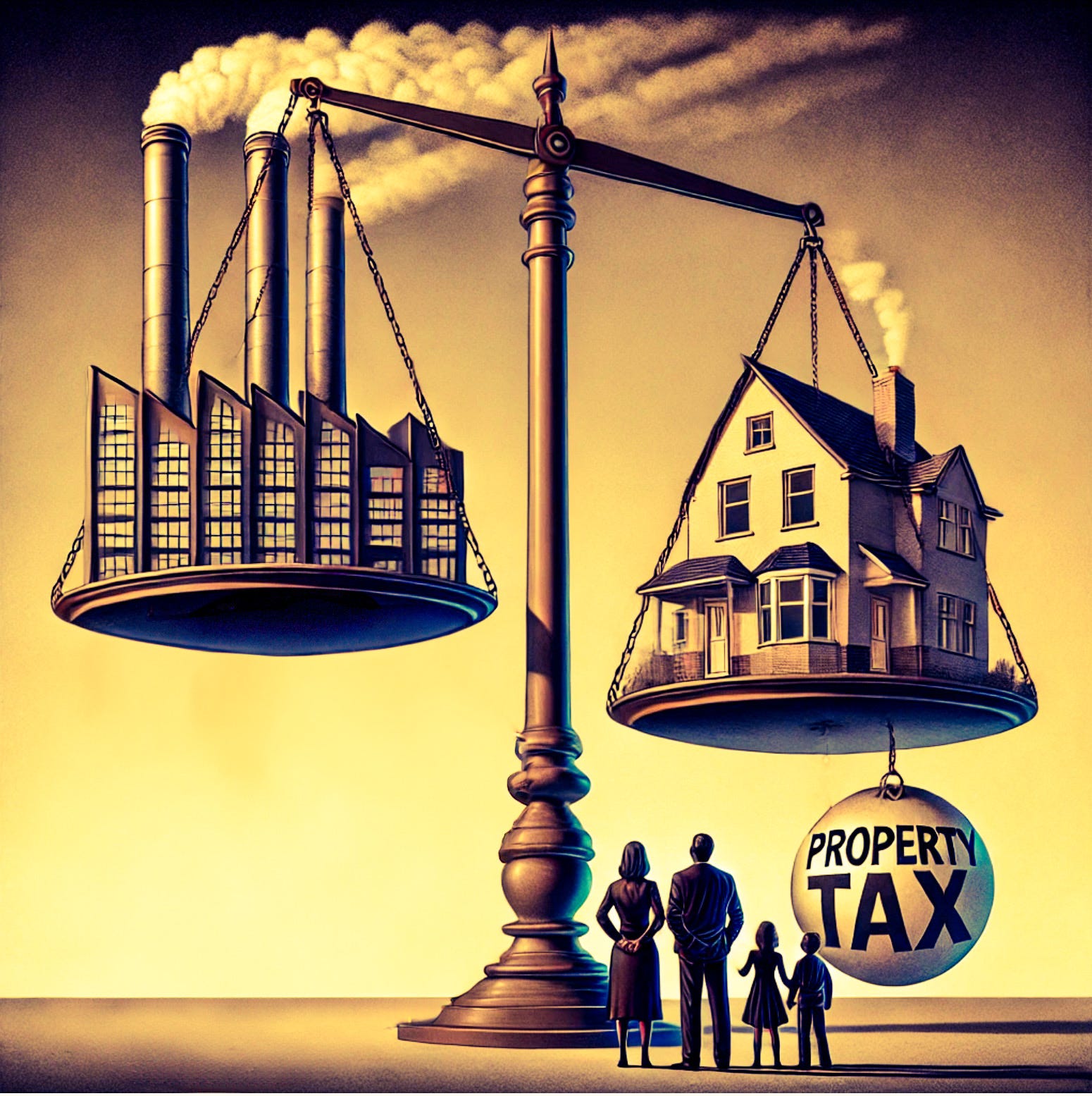
How This Research Started and Why So Many Idahoans Are Feeling It.
Over the past several weeks, Idahoans from Twin Falls, Jerome, Buhl, Kimberly, Hagerman, Filer, and everywhere in between, have reached out to me with the same concern:
“Why am I paying so much to the College of Southern Idaho on my property tax bill?”
I kept hearing it.
People sent screenshots.
They circled the line for CSI and asked me point-blank:
“Senator, how did this get here?”
“Why is a community college taxing my home?”
“And do the big corporations pay the same levy we do?”
Those were fair questions, so I dug in.
And like many things in government, the deeper you dig, the more you uncover.
Why CSI Appears on Your Property Tax Bill.
The legal origin: Idaho Code § 33-2111 (enacted in 1963)
The College of Southern Idaho’s taxing authority comes from a law passed more than 60 years ago, in 1963, when the Legislature created the framework for community college districts.
You can read the statute yourself here:
Idaho Code § 33-2111
This law gives a community college district the authority to certify a property-tax levy on every homeowner and landowner inside the district’s boundaries.
It wasn’t a secret change or a modern addition, it was part of a statewide push in the early 1960s to expand higher education into rural areas.
And once a district was created and approved by local voters, the levy power became permanent unless changed by statute or referendum.
Why the 1963 Legislature Created Community College Taxing Districts
A short historical sidebar
In the early 1960s, Idaho was facing several major challenges:
1. Idaho needed affordable workforce training.
Industries were expanding, and Idaho needed trained workers for:
manufacturing
agriculture technology
healthcare
business
trades
Community colleges were seen as the quickest way to build a skilled workforce.
2. Universities were too far away and too expensive for most rural families.
Idaho had only two major public universities, in Moscow and Pocatello.
Rural families in Magic Valley were priced out or too far from campuses.
Community colleges solved that.
3. The state didn’t want to fully fund the colleges from the General Fund.
Legislators insisted that:
local taxpayers,
local industry, and
local communities
…should help carry the financial responsibility.
So they created a three-legged funding system still used today:
State appropriations
Student tuition and fees
Local property taxes (the levy)
4. The levy was considered a “local choice.”
Communities were told:
“If you want a college, you must form a district and vote to tax yourselves.”
That is exactly how the College of Southern Idaho was formed.
Local voters approved the district.
The levy followed.
And here we are, sixty years later, still paying that same structural tax.
What CSI Actually Collects — The Hard Numbers
Here is the chart that started raising new questions for me.
It shows revenue for Idaho’s four community colleges.
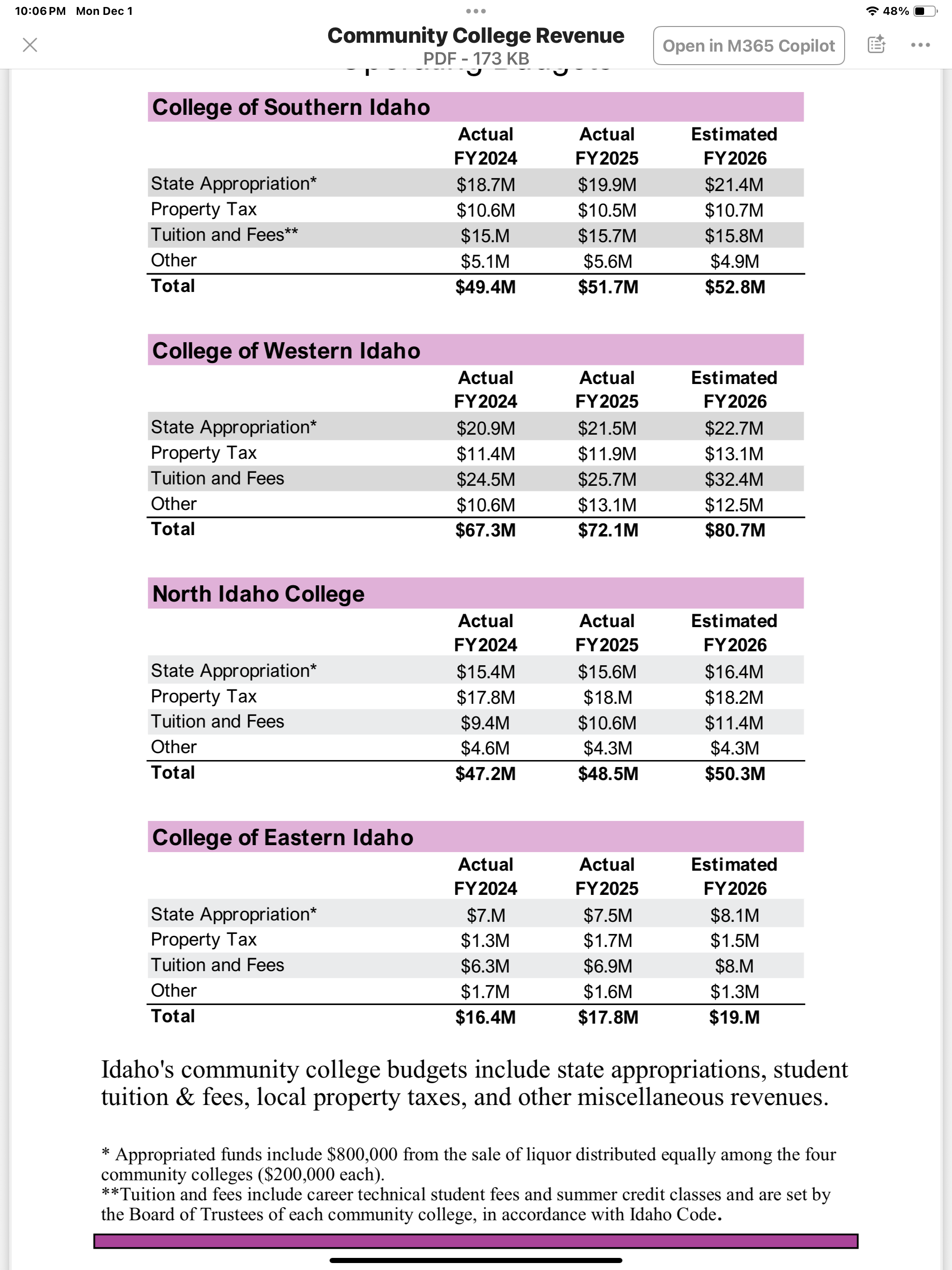
For those who want to analyze every detail themselves:
This is one of the most transparent budget documents available to the public.
This Is Where the Real Questions Began
When I saw that CSI collected:
over $10 million a year in property taxes
nearly $20 million in state appropriations
over $15 million in tuition and fees
over $4 million in other
…I began to wonder:
“Are homeowners carrying the majority of this load?”
“Do large corporations contribute proportionally?”
“Is the tax base shared evenly, or lopsided?”
That’s when I began digging into:
Urban Renewal Districts (URD/TIF)
Ag-land tax classifications
Government-owned commercial leases
Corporate incentives and exemptions
What I found is exactly what I share below.
Urban Renewal (URD/TIF): The Engine Behind Corporate Tax Diversions
In Twin Falls and Jerome, many large corporations sit inside Urban Renewal Districts, special zones where increases in property value are diverted away from schools and local services.
This diversion is called Tax Increment Financing (TIF).
Here’s how it works:
The base property tax still goes to local services.
The growth (the increment) goes to the Urban Renewal Agency.
This can last 20–30 years.
If you want to research it:
Twin Falls Urban Renewal Agency
When Chobani, Clif Bar, or other manufacturers expand, much of the added value never reaches:
the school district
the fire district
county services
the library
roads and public safety
Meanwhile, homeowners outside the URD shoulder the difference.
Growth pays for itself, just not for you.
It pays for the corporation.
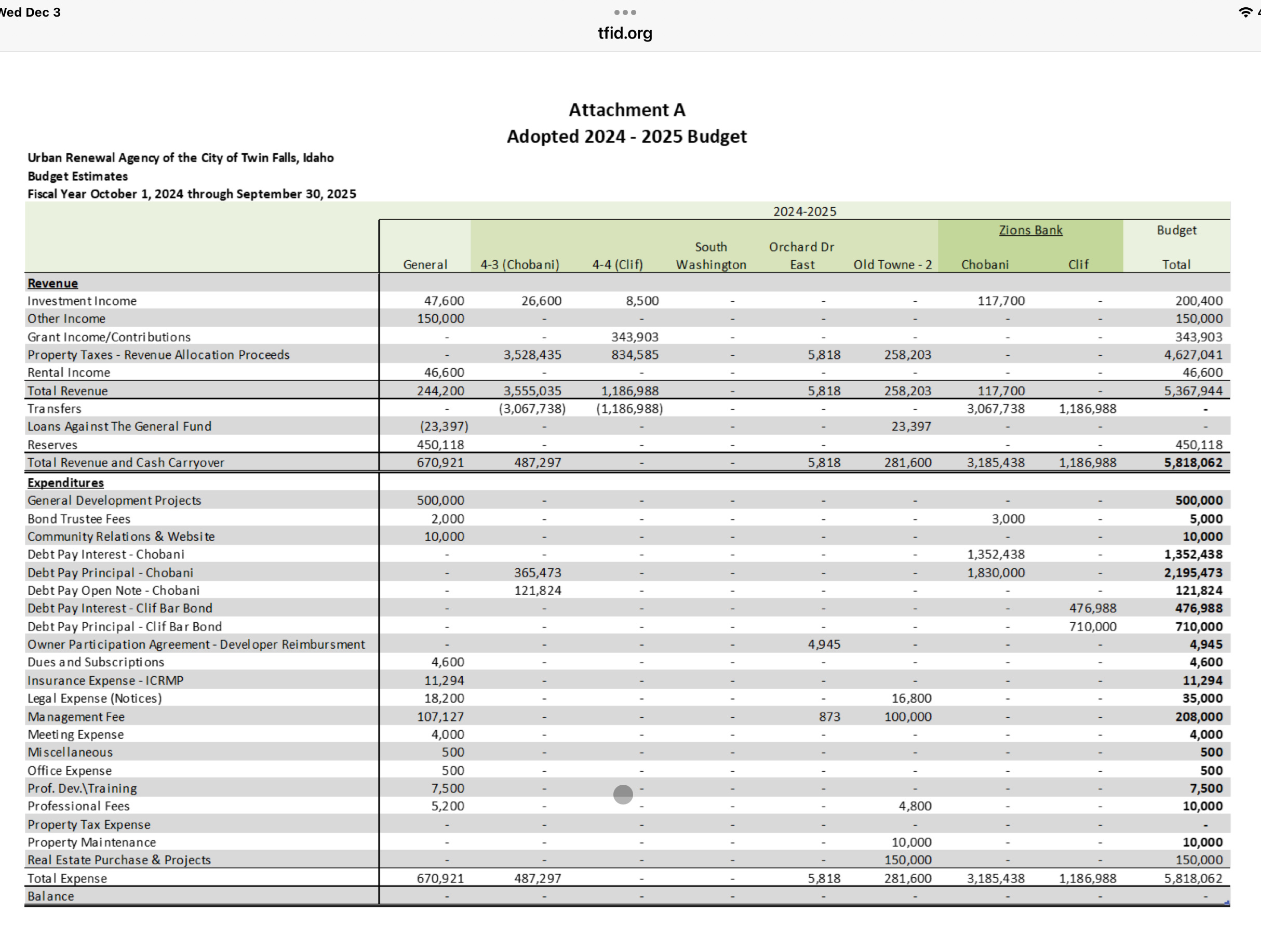
How Idaho Got Urban Renewal Districts — and Why
Urban Renewal in Idaho didn’t start in Twin Falls or Jerome.
It began in 1965, when the Legislature passed the Idaho Urban Renewal Law and the Local Economic Development Act. Both were modeled after federal redevelopment policies dating back to the 1949 and 1954 national Housing Acts.
Why Urban Renewal Was Created (the original intent)
In the 1950s and 60s, many American towns were facing:
deteriorating downtowns
aging infrastructure
“blighted” industrial blocks
population shifting out to the suburbs
Idaho lawmakers believed cities needed a tool to rebuild decaying areas without raising taxes.
So Urban Renewal Agencies (URAs) were created to:
clean up blight
improve streets, water, and sewer systems
redevelop struggling downtowns
encourage private investment in areas that otherwise wouldn’t attract it
Why Tax Increment Financing (TIF) was added
In the late 1960s and 70s, cities across America began using Tax Increment Financing (TIF) to pay for redevelopment projects without raising taxes. Idaho eventually followed this same model.
TIF works like this:
freeze the current tax value of an area
as new businesses come in and values rise, the increment goes back to the URA
the URA uses that money for roads, utilities, or developer reimbursements
This was supposed to last for a limited time, until the area was “rebuilt.”
The problem today
What started as a tool for blighted downtowns slowly evolved into:
industrial incentives
commercial development subsidies
long-term extensions of URDs
corporate tax diversions
financing growth without growth paying proportionally
URDs are still legal and heavily used, but their modern application has shifted far beyond their original purpose.
Instead of revitalizing truly blighted neighborhoods, many URDs now subsidize:
factories
processing facilities
data centers
distribution hubs
retail corridors
And as these large projects grow inside URDs, the increment never reaches:
schools
fire districts
highway districts
the general county fund
That is why homeowners outside the URD often see higher levies and rising tax bills.
Key Laws for Reader Reference:
Ag-Land Classification: Corporate Land at Discount Prices
Across the Magic Valley, corporate dairies and food processors own vast agricultural parcels.
Under Idaho law, ag land is taxed on productive value, not market value.
You can read the statute here:
IC § 63-604 — Agricultural Land Valuation
This means land worth millions can be taxed as if it were worth only a fraction of that.
That shifts burdens onto households and small businesses.
Government-Owned Properties Leased to Corporations
Many industrial tenants at or near the Twin Falls Airport lease buildings from:
the City
the County
the Airport Authority
Because the government owns the property, it is tax-exempt.
For reference:
IC § 63-602A — Government Property Exemption
Corporations pay only equipment tax, not property tax.
Again, the burden shifts.
The Tax Shift: Clear, Simple, and Real
Whether through URDs, ag classifications, or property exemptions, the pattern is consistent:
Homeowners pay more.
Large corporations pay less.
Is it illegal? No.
Is it transparent? Rarely.
Is it fair? You decide.
Real Examples from Jerome & Twin Falls
These are not allegations, they are documented facts:
Chobani — expansions inside a URD; tax increment diverted
Clif Bar (Mondelez) — URD incentives plus state job-creation credits
Glanbia — ag-land valuation reduces assessed value
Northbridge Junction (Jerome) — industrial development taxed through URD
Airport-area tenants — government-owned buildings = tax-exempt
If you want to explore these URDs:
Jerome Urban Renewal Agency
(Use “Area 3,” “Area 4,” “Area 5,” and “Northbridge.”)
The Heart of the Issue
You’re not imagining it.
Your property taxes keep rising because the system is designed to shift burdens away from high-value industrial property and onto homeowners.
When corporate growth doesn’t contribute proportionally, someone else covers the gap.
That “someone” is you.
Where Do We Go From Here?
Idaho’s growth is not the problem.
The problem is how the tax structure distributes the load.
I believe in business. I believe in local industry. And I’m genuinely grateful for employers who invest in our region and create opportunities for Idaho families.
But fairness matters.
Transparency matters.
And Idaho homeowners deserve to know exactly who’s paying and who isn’t.
As your Senator, I’ll continue shining a light where others prefer shadows. I’ll keep digging, asking uncomfortable questions, and pushing for accountability.
But here’s the truth:
I can’t face this alone. This is where you come in.
Get familiar with your:
city websites
county websites
taxing district boards
meeting calendars
Learn when they meet.
Learn what they vote on.
Learn who is making decisions with your tax dollars.
And then — show up.
Show up so consistently, so persistently, and so loudly (in a respectful Idaho way)
that they get tired of seeing your faces.
That’s how you change policy.
That’s how you impact budgets.
That’s how you take back local control.
Because the only thing more powerful than government, is the people who are paying for it.
We can’t fix what we won’t face.
And now, at least, we’re facing it together.
My pay-increase donation for October goes to Heather Stroup owner of Wag-n-Tongue, a local Twin Falls small-business owner fighting every day to keep her doors open in the middle of rising inflation.
If you want to strengthen our community, start with the folks right here at home. Support small businesses. Shop local.
Let’s keep our money local, where it strengthens our neighbors, our families, and the backbone of our Idaho towns.

Quote:
James Madison
“Charity is no part of the legislative duty of the government.”
— Speech in Congress, 1794
(Madison said this while opposing a federal aid bill, insisting that care for the poor belonged to individuals, churches, and local communities.)
Bible Verse:
1 Timothy 5:8 (ESV)
“But if anyone does not provide for his relatives, and especially for members of his household, he has denied the faith and is worse than an unbeliever.”
This verse places the primary responsibility for care squarely on individuals and families, not civil authorities. Paul lays out a system where personal duty, not governmental compulsion, is the foundation of charity.
To make matters worse, CSI went into business resettling refugees so it's a double whammy for Idaho taxpayers.
Outstanding report!